
Repair or Replace Your Controller – A Cost-Based Decision Framework for 2026
Table of Contents
You already know the deadzone workaround stopped working. You’ve already tried the reset button. The drift is confirmed hardware wear, and the Sony warranty window closed three months ago.
Now you’re sitting on a $70 replacement decision with no clear sense of whether a $45 repair is genuinely a better value, or whether you’d be better off spending the difference on something that doesn’t repeat this failure in eight months.
That’s the question this guide answers with specific numbers, not general advice.
Deciding to Repair Gamepad vs New Buy
It is a cost-benefit calculation based on three variables: the repair cost relative to replacement retail price, the controller’s age and remaining usable lifespan after repair, and whether the repair resets the original failure mode or eliminates it.
For stick drift specifically, a standard potentiometer module replacement resets the clock; a Hall effect module upgrade eliminates the failure mechanism, a distinction no mainstream repair guide makes explicit.
This guide covers PS5 DualSense, Xbox Series X|S controllers, and Nintendo Switch Joy-Cons. It does not address controllers with cracked housings from physical impact damage, water-damaged PCBs, or controllers requiring battery replacement; those fault types have different cost structures and repair viability profiles.
The Cost Numbers You Need Before Making This Decision
Deciding to repair or replace a controller starts with a price reality check. According to professional repair pricing compiled by Gizmo Pros (April 2026) and corroborated by Video Game 911’s repair documentation (2026), PS5 DualSense stick drift repair at a professional shop costs $35–$65, depending on whether one or both modules require replacement and whether the shop replaces with standard potentiometer modules or higher-cost Hall effect alternatives.
The replacement retail cost of a new DualSense sits at $69.99–$74.99 as of April 2026. That gap is narrower than most people assume, which is why the decision requires more than a gut feeling. At $35 for a single-stick repair on an otherwise fully functional controller, the repair makes clear financial sense.
At $65 for a dual-stick repair on a controller already outside warranty and approaching eighteen months of daily use, the math shifts toward replacement. You’re spending 87–93% of a new controller’s price to restore a device that will fail the same way again on the same timeline.
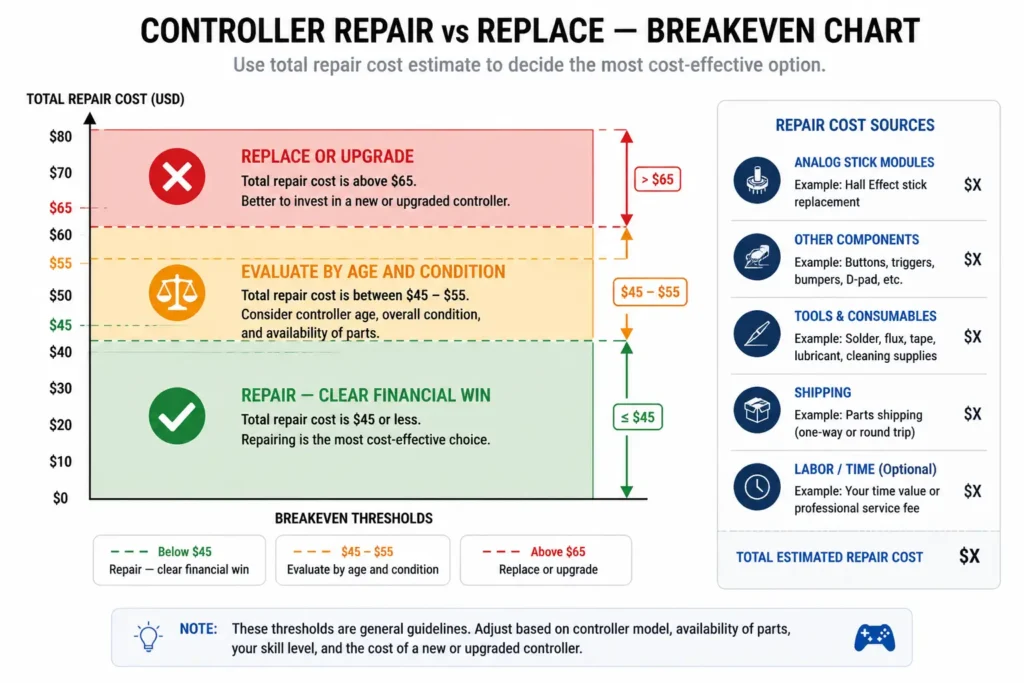
According to the same Gizmo Pros and Video Game 911 pricing data, the repair-vs-replace financial breakeven for a DualSense is approximately $45. Below that, repair wins on cost. Above $55, replacement becomes rational. The $45–$55 range requires a second input: how old is the controller, and how many faults does it have beyond the stick drift?
Here’s the thing: every repair guide gives you a process. None of them gives you this number. It’s the single most useful piece of information for making the decision, and it’s rarely stated explicitly.
The Three Repair Paths – Ranked by Cost, Skill, and Outcome
Path 1 – Professional Repair Shop ($35–$65, No DIY, 90-Day Warranty)
uBreakiFix by Asurion is the largest national chain in the US offering same-day PS5 controller repairs with standardised pricing and a 90-day parts and labour warranty. No appointment required at most locations.
Bring the controller in, describe the fault, and receive a cost estimate before any work begins. The 90-day warranty is meaningful if the repair fails within that window; you return it at no additional cost.
Independent repair shops typically charge $30–$50 for the same single-stick replacement and may have shorter turnaround times, but warranty terms vary significantly. When choosing an independent shop, ask two specific questions before leaving the controller: what module brand they’re replacing with (OEM-equivalent or aftermarket), and what their warranty period covers.
A shop that installs an aftermarket potentiometer module and offers a 30-day warranty is not giving you equivalent value to uBreakiFix’s 90-day standardised terms.
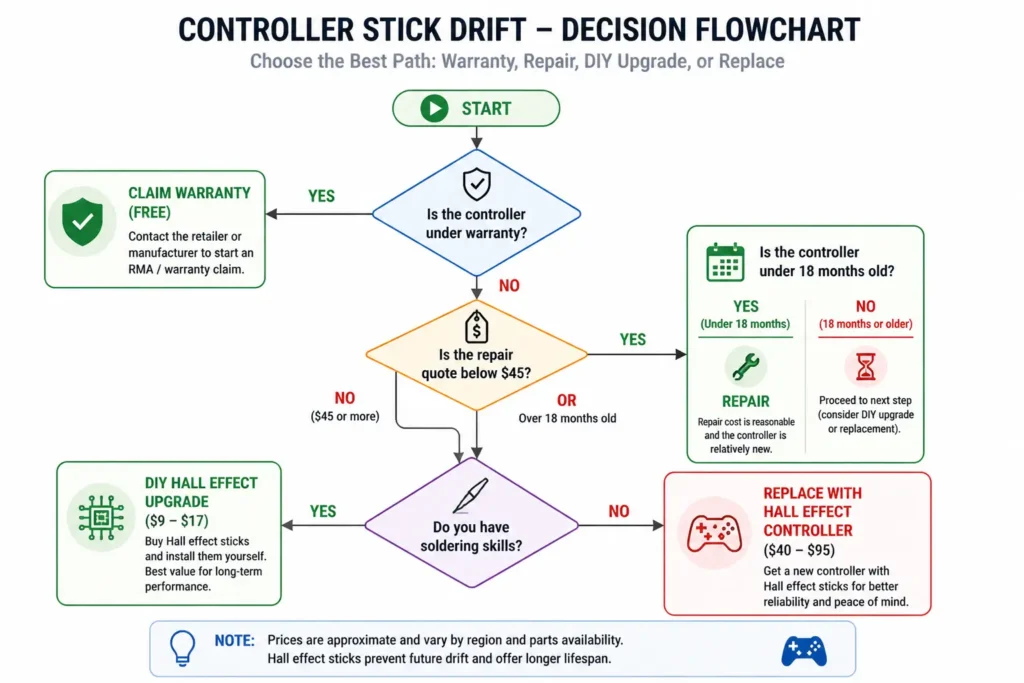
Professional repair makes sense when you have no soldering experience, the controller is under 18 months old with isolated drift on one stick, and the shop quote comes in below $45.
Path 2 – DIY Potentiometer Replacement ($8–$15 in parts, Moderate Skill)
The iFixit PS5 DualSense repair guide is the most reliable free walkthrough available step-by-step photography, a repairability score, and a compatible parts list that links directly to replacement modules. The DualSense scores a 9 out of 10 for repairability on iFixit’s scale, meaning disassembly is accessible with standard tools and no proprietary fasteners block access to the stick modules.
To replace a PS5 DualSense stick module at home, follow these steps:
- Order a replacement joystick module compatible with DualSense, and confirm the SKU against iFixit’s parts list.
- Use a Y0 Tri-point screwdriver to remove the four rear screws and separate the shell halves.
- Disconnect the battery ribbon cable before touching any PCB components.
- Desolder the two anchor pins and three signal pins on the defective module.
- Solder in the replacement module, verify pin seating, and test before reassembly.
- Reconnect all ribbons, re-seat the shell, and retest drift using a browser gamepad tester.
The honest caveat: this requires soldering. A first-time solderer working directly on a DualSense PCB is at meaningful risk of bridging a pad or pulling a trace, either of which can cause permanent board damage, more expensive to fix than the original drift.
DIY potentiometer replacement makes sense for players who have soldered before. For everyone else, the risk-adjusted value of professional repair is better even at higher labour costs.
Quick note: DIY potentiometer replacement resets the clock. The replacement module will wear on the same timeline as the original; you’re getting fresh hardware, not a different mechanism.
LEARN MORE → iFixit PS5 DualSense teardown and repair guide
Path 3 – DIY Hall Effect Module Upgrade ($9–$17 in parts, Same Skill Level as Path 2)
This is the path no mainstream repair article covers, and it changes the decision calculus significantly.
What most guides skip is that replacing a worn DualSense potentiometer with a GuliKit TMR joystick replacement module available from GuliKit directly and from third-party sellers, reviewed by siemens-mobile.com among others, costs only marginally more than a standard potentiometer replacement ($9–$17 vs $8–$15) and uses the same installation procedure.
The disassembly is identical. The soldering requirement is the same. The outcome is categorically different: instead of resetting the potentiometer failure clock, you permanently eliminate the failure mechanism by replacing the resistive wiper-on-track design with a non-contact magnetic sensor.
A DualSense with GuliKit TMR modules installed is objectively more durable than a brand-new stock DualSense, because the new stock controller ships with the same potentiometer hardware that produced the original drift. This is the single most cost-effective outcome available at the DIY skill level, a permanent hardware upgrade for $9–$17 in parts.
Or maybe I should say: if you’re going to open the controller and solder anyway, there is almost no reason to replace like-for-like rather than upgrading the module type. The marginal cost difference is $5–$7. The outcome difference is permanent drift elimination versus temporary relief.
READ MORE → What Hall-Effect means for long-term reliability
The Decision Matrix – Your Controller’s Situation, Mapped to a Verdict
DIY Hall effect upgrade vs. professional repair: A DIY Hall effect module upgrade is better suited for controllers under 24 months old with isolated stick drift and no other concurrent faults, because the $9–$17 parts cost permanently eliminates the drift mechanism and produces a more durable result than a stock replacement.
Professional repair is better suited for players without soldering experience who have a single-fault controller under 18 months old and a shop quote below $45, because the 90-day warranty offsets the higher cost of professional labour for a risk-free outcome. The key difference is permanence: professional repair with potentiometer modules resets the failure clock; DIY Hall effect upgrade eliminates the clock.
Quick Comparison
| Option | Best For | Cost | Outcome | Limitation |
| Professional repair (potentiometer) | No DIY skills; single-fault controller under 18 months | $35–$65 | Drift resolved; same timeline resets | Drift will recur; shop warranty varies |
| DIY potentiometer swap | Have soldering experience; want the lowest parts cost | $8–$15 | Drift resolved; clock resets | Same failure mode returns |
| DIY Hall effect/TMR upgrade | Have soldering experience; want a permanent fix | $9–$17 | Drift eliminated permanently | Requires the same skill as a potentiometer swap |
| New stock DualSense | Controller over 24 months with multiple faults | $69.99–$74.99 | Fresh hardware, same potentiometer design | Will drift again on the same timeline |
| New Hall effect controller | Multiple drift incidents; ready to leave first-party | $40–$95 | Drift eliminated; often better specs | Costs more; no DualSense haptic features |
Look, if your DualSense is between 12 and 18 months old, has drift on one stick, and no other faults, here’s what actually works: get a GuliKit TMR module kit, follow iFixit’s DualSense teardown guide, and upgrade instead of restore. Total out-of-pocket is $9–$17.
The controller comes out of the repair permanently better than new. That’s a better outcome than either a professional potentiometer swap or a like-for-like replacement, and it costs less than both.
The Xbox and Switch Versions of This Calculation
The Xbox Series X|S controller follows a nearly identical cost analysis. Retail replacement cost for an Xbox Core is $59.99–$64.99 in April 2026. Professional stick drift repair runs $30–$55 at comparable shops, with the same $40–$45 financial breakeven threshold.
GuliKit and Extremerate both produce Hall effect replacement modules for Xbox Series controllers at $12–$20 the same upgrade path is available, and the same logic applies: if you’re opening the controller anyway, upgrade the module type.
Nintendo Switch Joy-Con drift is a meaningfully different situation. Nintendo has extended its Joy-Con repair program, offering free drift repairs for Joy-Cons regardless of warranty status in most major markets, including the US, UK, and EU, following sustained consumer pressure and regulatory attention beginning in 2020 and continuing through 2026 updates.
Before spending any money on Joy-Con drift repair, verify current eligibility at Nintendo’s official support site. Paying for a Joy-Con repair that Nintendo would have done for free is the one genuinely unnecessary cost.
I’ve seen conflicting data on whether Nintendo’s free repair program still covers all Joy-Con models as of 2026. Some sources indicate the program scope has narrowed to specific production runs, while others report it remains broadly available.
My read: contact Nintendo support directly before spending on a third-party repair. Even if your specific Joy-Con no longer qualifies for the program, Nintendo’s official repair charge for out-of-program Joy-Cons is typically lower than third-party shops.
Frequently Asked Questions
Q: Is it worth repairing a PS5 controller with stick drift?
A: Yes, if the professional repair quote is below $45 and the controller is under 18 months old with no other faults. Above $55 in repair cost on an older controller, a new or Hall effect replacement is more cost-effective over 12 months of use.
Q: How much does PS5 controller stick drift repair cost at a shop?
A: According to Gizmo Pros’ April 2026 pricing and Video Game 911’s repair guide, professional DualSense drift repair costs $35–$65, depending on whether one or both sticks require replacement and whether the shop uses standard or Hall effect modules.
Q: Should I repair my controller myself or take it to a shop?
A: If you’ve soldered before, DIY is the stronger choice, especially if you upgrade to Hall effect/TMR modules for $9–$17 rather than replacing like-for-like. Without soldering experience, the risk of PCB damage during a first attempt makes professional repair a better value, even at a higher cost.
Q: When should I replace my controller instead of repairing it?
A: When the controller is over 24 months old, has multiple concurrent faults beyond drift, or the repair quote exceeds $55–$65 at that cost, a new controller or a Hall effect upgrade model offers better long-term value than restoring a device with an already-worn potentiometer-based design.
Q: Can I upgrade my DualSense to Hall effect sensors instead of just replacing the old ones?
A: Yes. GuliKit TMR module replacement kits for the DualSense cost $9–$17 and use the same installation process as a standard potentiometer swap. The result is permanent drift elimination rather than a temporary reset, making it the most cost-effective repair outcome for anyone with basic soldering experience.
This guide covers stick drift repair decisions for PS5 DualSense, Xbox Series X|S controllers, and Nintendo Switch Joy-Cons as of April 2026. Prices reflect April 2026 market conditions. It does not cover impact damage, water damage, battery replacement, or trigger mechanism faults — those fault types have different cost profiles and repair viability assessments not covered here.