
The Best Gamepad 2026 – Ranked by Drift-Free Tech, Latency, and What You Actually Get at Each Price
Table of Contents
If you’ve replaced a controller once because of stick drift and you’re about to do it again, this guide starts differently from most. The Xbox Core Controller and PS5 DualSense are not on this list as primary recommendations.
Not because they’re bad controllers, but because both still use potentiometer-based analog sticks that will drift on the same timeline as every previous controller you’ve owned, and recommending them without that disclosure is exactly what the affiliate-driven roundups you’ve already read have been doing.
The 2026 market looks meaningfully different from 2023. Hall effect joysticks, magnetic, non-contact sensors that don’t have a wearable carbon track, have moved from a niche premium feature to a mid-range expectation.
TMR sensors, a more precise magnetic variant, are appearing in the esports tier. And 1000Hz polling, once exclusive to $150+ hardware, is now available at $60. The question isn’t whether you can afford a drift-resistant controller. It’s which one matches your platform, budget, and play style.
The Best Gamepad 2026
This is the one that matches your primary platform, preferred wireless protocol, and budget tier while using Hall effect or TMR joystick technology, since potentiometer-based sticks are the proven failure point in every first-party controller currently on the market. The rankings below are tiered by use case, not by arbitrary score.
This guide covers PC (Windows 10/11), PS5, and Xbox Series X|S. It does not address Nintendo Switch-specific controllers, arcade sticks, racing wheels, or flight controllers; those hardware categories have different feature priorities and buying criteria.
What Changed in 2026 – Why This Year’s Market Looks Different
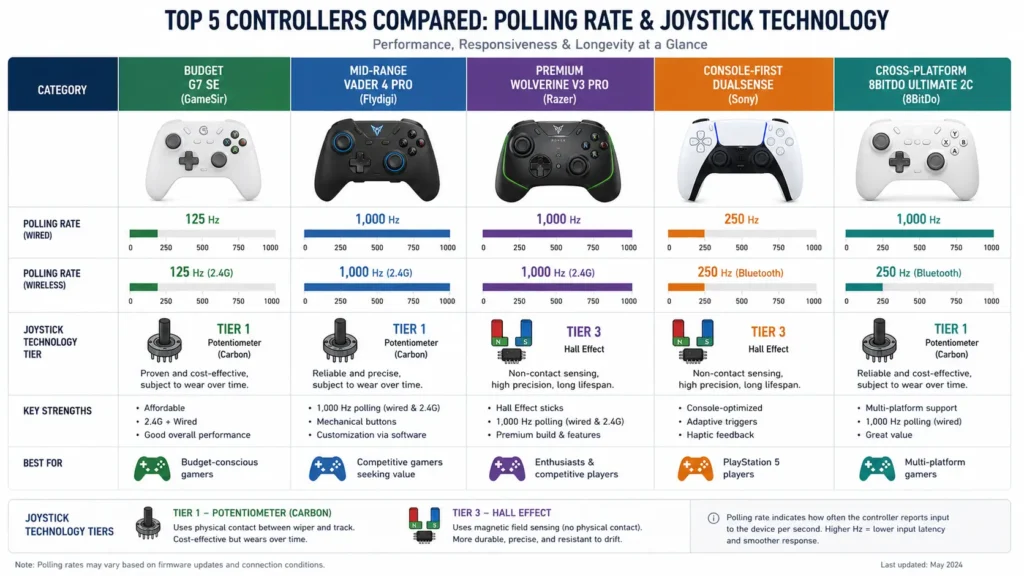
The headline shift is polling rate democratisation. According to TopChoiceFor.com’s benchmarked roundup of 35 tested PC controllers (March 2026), the Flydigi Vader 4 Pro ranked first overall, and it achieves 1000Hz polling in both wired and wireless modes at a mid-range price point.
Two years ago, 1000Hz wireless was a spec you paid $180+ to access. That compression of the feature tier means the value calculus across all price categories has shifted significantly upward in 2026.
The second shift is the mainstream arrival of the Hall effect in budget hardware. The GameSir G7 SE, available for under $45 as of April 2026, ships with Hall effect joysticks and Hall effect triggers in an Xbox-compatible plug-and-play package.
According to hlplanet.com’s controller technology tracking, the G7 SE is widely credited with making Hall effect technology a mainstream expectation at the budget tier rather than a premium differentiator. Its existence means there is no longer a legitimate reason to buy a potentiometer-based controller at any price.
One thing the market hasn’t fully resolved yet: the difference between Hall effect and TMR Tunnel Magnetoresistance sensors. Most guides treat them as equivalent. They aren’t. Both are non-contact magnetic sensors, but TMR offers higher signal resolution and lower inherent noise floor than standard Hall effect, translating to more precise axis readings at fine movement inputs.
Razer’s entire 2026 premium lineup, including the Wolverine V3 Pro, uses TMR sensors specifically for this reason. The distinction matters if sub-millimetre stick precision is a priority; it matters less if your primary goal is simply eliminating drift.
The Ranked Picks – By Budget and Use Case
Budget Pick Under $45 – GameSir G7 SE
The G7 SE is the clearest value inflection point in the 2026 controller market. Hall effect joysticks, Hall effect triggers, wired USB-C, native Xbox XInput compatibility on PC, and Xbox plug-in, it works, no middleware, no DS4Windows, no x360ce.
The polling rate is 125Hz, which is the standard for wired budget controllers and produces a worst-case polling lag of 8ms, well within acceptable bounds for any game outside esports-tier competitive play.
The face buttons use rubber dome membranes rather than tactile switches, which is the expected trade-off at this price. No wireless. No rear buttons. No adjustable tension. For a player whose primary frustration is repeated stick drift and whose budget doesn’t extend to mid-range, the G7 SE eliminates the failure mode for $40.
Look, if you’re a casual-to-moderate PC gamer who has replaced a drifting Xbox Core twice and wants the problem permanently solved without spending more than $45, here’s what actually works: the G7 SE does exactly one thing exceptionally well, which is delivering drift-free Hall effect inputs on a tight budget. Buy it, register it, and stop thinking about stick drift.
LEARN MORE → hlplanet.com controller technology tracking
Mid-Range Overall Pick – Flydigi Vader 4 Pro (~$80–$95)
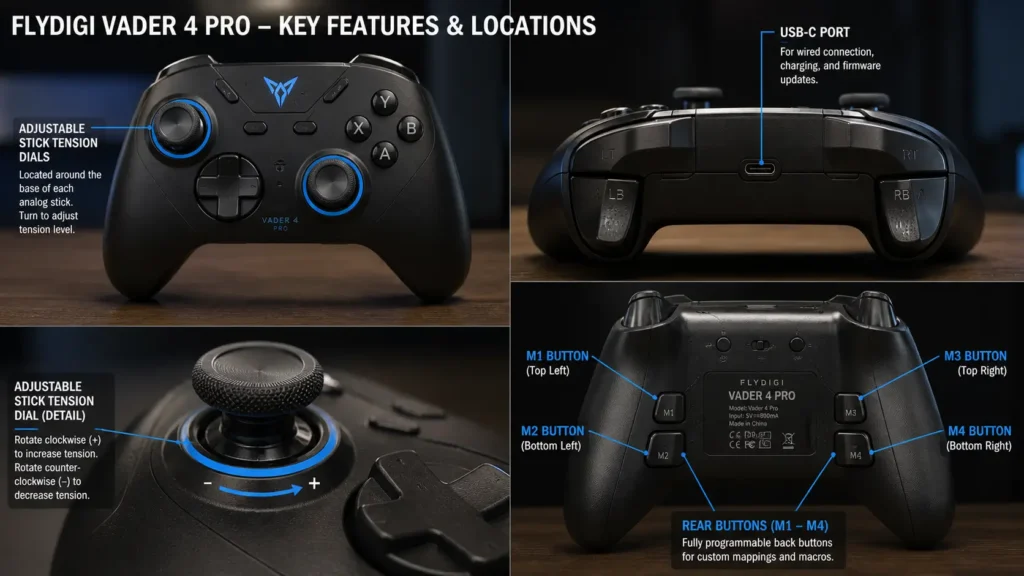
The Vader 4 Pro is the most technically capable controller available at its price point in 2026 by a measurable margin. Hall effect joysticks and triggers, 1000Hz polling in wired and wireless mode, adjustable stick tension via a physical dial, four programmable rear buttons, and support for PC, Xbox, Switch, Android, and iOS simultaneously from one device.
According to TopChoiceFor.com’s March 2026 benchmark of 35 tested controllers, it ranked first overall across the full field, not just within its price tier.
The wireless connection uses a proprietary 2.4GHz dongle, which brings it to approximately 3–6ms latency in wireless mode, well below Bluetooth’s 16ms baseline. Battery life is rated at approximately 20 hours on a single charge. The companion Flydigi Space Station app on PC handles button remapping, stick tension calibration, deadzone configuration, and firmware updates.
Or maybe I should say: the Vader 4 Pro doesn’t feel like a mid-range controller when you’re using it. The adjustable stick tension alone, which lets you dial in resistance from light to firm on each stick independently, is a feature that $150 controllers were charging a premium for two years ago.
Quick note: the Vader 4 Pro uses Flydigi’s proprietary 2.4GHz dongle for wireless. It does not support the Xbox Wireless protocol, meaning it won’t connect wirelessly to an Xbox console. A wired connection to the Xbox is supported. For cross-platform players who need native wireless on Xbox and PC, the next section covers that.
Premium Pick – Razer Wolverine V3 Pro (~$199)
The Wolverine V3 Pro is for one specific buyer: the competitive FPS player on PC who has already eliminated every other latency variable and wants a controller that introduces no further bottlenecks. 8000Hz polling rate, the highest currently available in any gamepad, combined with TMR joystick sensors, mouse-click mechanical face buttons with rated lifespans far exceeding standard rubber dome membranes, and 2.4GHz wireless at sub-5ms average latency.
The TMR sensor advantage over standard Hall effect is specific: it produces a higher signal resolution across the stick’s travel range, which translates to finer gradations between axis value steps relevant for competitive shooters where micro-aim adjustments need to register as distinct inputs rather than being rounded to the nearest step on a lower-resolution sensor.
At 8000Hz polling, the controller is sending a new input report every 0.125ms eight times per millisecond, which is overkill for most play styles and genuinely relevant for reaction-based competitive scenarios.
The trade-offs are real. At $199, this is a significant investment. Battery life is shorter than the Vader 4 Pro at approximately 28 hours (manufacturer rated). The Wolverine V3 Pro does not support an Xbox console native wireless 2.4GHz dongle for PC only, wired for Xbox. And the mouse-click face buttons are loud. In shared spaces, they’re divisive.
Console-First Pick – PS5 DualSense (with Honest Caveats)
The DualSense remains on this list specifically for PS5 console players who want the best native experience on that platform. The LRA haptic actuators, adaptive triggers, and gyro integration in PS5-optimised games are hardware features unavailable in any third-party controller that supports the PS5 natively. On the PS5 console, the DualSense is still the correct answer.
On PC, the picture is different. The DualSense connects as a DirectInput HID device and requires either Steam Input or DS4Windows to emulate XInput for most games.
Running both simultaneously causes the double-input bug, every button press registers twice, which requires HidHide to resolve by hiding the physical device from Steam while DS4Windows maintains its own whitelisted access.
The haptic LRA actuators only function at full capability in the small subset of PC games that have implemented Sony’s haptic SDK natively; for everything else, it falls back to standard rumble output. And the joystick sensors are potentiometer-based, meaning drift on the same timeline as any other first-party controller.
For PC-primary players, the DualSense is a worse value at $69 than the Vader 4 Pro at $80–$95 because you’re paying for hardware features (haptics, adaptive triggers) that require platform-specific support you won’t get in most PC games, while accepting the same drift-prone joystick technology you’re trying to escape.
READ MORE → How to fix PS5 DualSense not working on PC and the double-input bug
Cross-Platform Budget-Premium Pick – 8BitDo Ultimate 2C Wireless (~$35–$45)
The 8BitDo Ultimate 2C Wireless offers Hall-effect joysticks and Hall-effect triggers, 2.4GHz wireless, a charging dock, and official 8BitDo Ultimate Software support for button remapping and deadzone adjustment at a price point that undercuts most of the competition.
It lacks rear buttons, and the polling rate is 125Hz in wireless mode, so it’s not competing with the Vader 4 Pro on performance specifications. What it offers instead is the most accessible Hall effect wireless controller for players who want to move between PC, Switch, and Android without carrying multiple devices.
The 8BitDo software ecosystem is the strongest of any third-party manufacturer at this price tier. The companion app is updated regularly, the customisation is thorough, and profiles save to the controller’s onboard memory. Players already in the 8BitDo ecosystem will find the Ultimate 2C Wireless a natural and cost-effective upgrade path.
Quick Comparison
| Controller | Best For | Joystick Tech | Polling Rate | Wireless | Price (April 2026) |
| GameSir G7 SE | Budget drift-free PC/Xbox | Hall effect | 125Hz | None (wired) | ~$40 |
| Flydigi Vader 4 Pro | Best overall mid-range PC | Hall effect | 1000Hz wired & wireless | 2.4GHz dongle | ~$80–$95 |
| Razer Wolverine V3 Pro | Competitive esports PC | TMR (Tunnel Magnetoresistance) | 8000Hz | 2.4GHz dongle | ~$199 |
| PS5 DualSense | PS5 console play specifically | Potentiometer | 250Hz USB | Bluetooth | ~$69 |
| 8BitDo Ultimate 2C | Cross-platform Hall effect wireless | Hall effect | 125Hz wireless | 2.4GHz dongle | ~$35–$45 |
One Honest Disagreement With the Market Consensus
I’ve seen conflicting positions on whether TMR sensors are meaningfully better than Hall effect for typical gamers, or whether the distinction is primarily a marketing differentiation that Razer is exploiting to justify premium pricing.
Some controller hardware reviewers argue that the practical difference is indistinguishable under normal play conditions at standard polling rates. Others cite measurable axis resolution improvements in controlled testing.
My read: the TMR advantage is real and measurable in isolation, but it only becomes practically meaningful in conjunction with 1000Hz+ polling and in game genres where micro-input precision determines outcomes, specifically competitive FPS. For everyone else, the gap between TMR and Hall effect is smaller than the gap between Hall effect and potentiometer at any polling rate.
Some buying guides in 2026 still recommend the Xbox Core Controller as a safe default pick. That’s defensible if the buyer prioritises brand familiarity, Xbox console native wireless, and Microsoft’s build quality; those are legitimate factors. But the Core still uses a potentiometer joystick.
Recommending it without that disclosure, in a year when Hall effect alternatives exist at the same or lower price points, is a disservice to the reader. The GameSir G7 SE at $40 is a better buy than the Xbox Core at $59 for any PC-primary player whose primary concern is drift longevity.
Anyway, the 2026 market has closed the price gap enough that “I’ll accept potentiometers to save money” is no longer a rational trade-off at any price tier above $30.
Frequently Asked Questions
Q: What’s the best gamepad for PC gaming in 2026 overall?
A: The Flydigi Vader 4 Pro at $80–$95. It offers 1000Hz polling in wired and wireless modes, Hall effect joysticks and triggers, adjustable stick tension, four rear buttons, and multi-platform support specs that ranked it first among 35 tested controllers in TopChoiceFor.com’s March 2026 benchmark.
Q: Should I buy a Hall effect controller, or is a regular Xbox controller fine?
A: If you’ve experienced stick drift before and play more than an hour daily, a Hall effect controller eliminates the failure mode. The Xbox Core still uses a potentiometer joystick that will drift on the same timeline. Hall effect options exist at the same or lower price points in 2026.
Q: How do I use a PS5 DualSense on PC without the double-input bug?
A: Install DS4Windows and enable HidHide to hide the physical device from Steam while DS4Windows maintains access. Disable Steam Input for your DualSense in Steam Settings → Controller. This prevents both tools from presenting the controller simultaneously, which is the cause of double-input registration.
Q: What is TMR, and is it better than the Hall effect?
A: TMR Tunnel Magnetoresistance is a non-contact magnetic sensor with higher signal resolution than the standard Hall effect. Both eliminate drift; TMR adds precision at fine input levels. Used by Razer’s 2026 premium lineup. For most gamers below the esports-competitive level, the Hall effect is sufficient.
Q: When should I spend $199 on the Razer Wolverine V3 Pro instead of the Vader 4 Pro?
A: If you compete in reaction-based FPS games where 8000Hz polling and TMR sensor resolution could produce measurable accuracy improvements, and where the $100 price gap is acceptable for marginal hardware gains. For any other play style, the Vader 4 Pro at $80–$95 provides no meaningful performance deficit.
This guide covers gamepads for PC (Windows 10/11), PS5 console, and Xbox Series X|S as of April 2026. Prices and availability reflect April 2026 market conditions and will shift. It does not cover Nintendo Switch Joy-Con replacements, arcade stick hardware, or racing wheel controllers those categories have different performance criteria and different manufacturer rankings.